Wednesday, June 23, 2010


Taste and see that the Lord is good (from Psalm 34)

I’m reading a book entitled “Take This Bread”, by Sara Miles. It’s an autobiographical story of a woman who became a Christian when she was encountered by Christ in Holy Communion. “I didn’t find God,” she says, “God found me.” In fact, Ms. Miles isn’t all that sure she was looking for God. One Sunday morning, a little wave of curiosity washed over her when she saw an Episcopal church. Their doors were open (literally, the doors were open), she heard the sounds of the congregation in worship, and she stepped through those doors.

But her awakening to faith in Christ happened when she was given a piece of bread. Jesus was placed in her hand. She ate the bread and was moved to tears, like the rest of us not totally understanding what happens there in that meal, but overwhelmed by the way she was being touched by God, and touching God. Sara Miles had been raised an atheist.

She was baptized a year later. The same week of her baptism, she started a community food pantry in the church’s sanctuary. The altar table was the first to be loaded up with things like canned corn, apples, and bags of rice. That pantry is still operating, mostly with the help and leadership of people who once were clients of the pantry.

Throughout the book, Ms. Miles is careful to note that from her perspective, receiving Jesus in a piece of bread at communion is the same thing as distributing Jesus to another human being by giving a can of corn. So it made sense to her to use the altar for this “program”. She began to see the Friday pantry shift as another time of worship. In fact, the priest of that congregation asked Sara to include the number of people receiving food in their worship attendance registry.

My message to you is that I hope you consider serving communion. Week after week the sign-up sheet has been blank. So on most Sundays before worship begins, I “scope out” the congregation to see who might be willing to serve Jesus. I have begun sharing the responsibility of handing out bread. Two positive benefits to that are that others get a chance to place Jesus in the hands of recipients, and I get to pray a short prayer or say a blessing for others as I come around with the chalice. It’s a wonderful experience.

The first time I served communion, I was a student in college. I helped in our local congregation in Issaquah Washington. After the service I remarked to Pastor Larry how powerful and significant that experience was, that I got to see the faith of the person as they waited for me to place Jesus in their hand. It was actually quite profound. And humbling.

Would you like to be part of that? There’s room for you to serve! Taste and see that the Lord is good.

Wednesday, May 26, 2010

A Happy Boy, and a not-yet happy reader


This is another short post on a scandinavian novel. Bjørnson's "A Happy Boy", finished in 1860, this is a story about the coming-of-age of a boy named Oyvind. He approaches life with a positive outlook in general, but as his relationships expand and as his responsibilities stack up, he learns that the world has a colder edge to it, and that his place in caste creates barriers to his dreams. Weaving through this story is a budding love with a feisty girl named Marit.

My struggle doesn't have anything to do with the novel. It has to do with Kindle for Mac. I got the free download for my Macbook Pro and my iPod Touch. The cool thing about that software is that it syncs to where I was reading, whether I was using my computer or my iPod. Another great thing is that this book was downloaded for free (it's public domain) and I received it all but instantly. No shipping costs. A great way to try out this e-book phenomenon. No costs whatsoever unless you want to count your DSL hookup. And the devices you use.

The downside to an e-reader is that I felt limited by the one-screen-at-a-time functionality. Yes I know, a person can turn back to a previous page, but I had the sense that I was walking on a beam with my reading. As one who tends to back read, it was bothersome.

I found that the Kindle for iPod was tooled out better than for the Mac. You would think it would be the other way around. With the iPod I could "dog ear" pages, but I didn't experiment with that too much. With the iPod I could also write my own notes and attach them to the text, even in this free book.

The Mac version of the software would do well to build in some of these interactive tools. Full note functionality. Dictionary. Bookmarking. Since it's digital a concordance would be handy.

I will try again. The convenience of getting a book by download is wonderful, but the interface needs work, in my humble opinion.

Wednesday, May 19, 2010

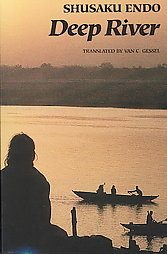
Shusaku Endo, "Deep River"


This is the second book I've read by Endo. The first was an amazing look into the early days of Christianity in Japan titled "Silence." If you want to know what it's like to suffer for the sake of faith, in my context Christian faith, that book will strike you in the heart.

This book "Deep River" is more modern in context, but it brings up ancient faith and practices. A group of Japanese tourists travel to India as a tour group. The way Endo introduces them somehow reminds me of Chaucer's "Canterbury Tales," where the sitz im leben of each individual pilgrim is brought to bear.

But no direct comparisons can be drawn. This story belongs to Endo, and to every seeking, spiritually wondering and wandering person. At the center of the story is a woman named Mitsuko, who is appalled by deep spiritual ferver, and yet is attracted to it. Whether she moves closer to God through her experiences remains to be seen.

But coursing through the novel is the River Ganges, and in particular the spiritual interaction that everyone in the story has with it. It is accepting and constant, and like God, it draws all things to itself. It draws out of people emotions and actions that heretofore they wouldn't have considered.

This is a good story to use to think about the "suffering servant." It is also a good story to use when wanting to describe how confession happens inside the human heart when met by things like beauty, death and pathos.

Enough rambling. Hey, I actually used the word heretofore.

Monday, May 10, 2010

Kristin Lavransdatter


Lately I've been very interested in Scandinavian culture and history, especially Norwegian. I've read a collection of plays by Henrik Ibsen, earlier I read a book called "The Emigrants" by Wilhelm Moberg (Swedish). Now I'm reading the first of a trilogy by Sigrid Undsett, Kristin Lavransdatter.

It's set in 14th century Norway, during a time when a social and economic caste system was strictly followed. Men sought honor and prestige. Women did the best they could with the circumstances they were afforded, either by fate (God) or their man.

Kristin grows up in this first installment. She finds love (sometimes noticing it too late) and struggles between new loves and loyalty to her loving father. This story is a wonderful re-telling of the tangled mess that relationships become. There are power struggles, deep-set anxieties, fears and joys.

Sigrid Undsett was a wonderful storyteller. If you want a glimpse into Norwegian culture, history and contemporary caricatures, this is a great place to start. This work is a new translation, overdue according to the translator Tiina Nunnally. With her contributions the novel has a great contemporary feel.

Wednesday, December 30, 2009

Scribble Scribble Scribble


Here is my newsletter article for our January newsletter. Hope you enjoy! Credit is here given to Walter Brueggemann for his poem, "Re-text Us"

“Create in me a clean heart, O God, and renew a right spirit within me” (from Psalm 51)


Dear St. Paul,

Someone close to me says like clockwork every January, “Maybe this will be my year.” We’re turning another corner! Flipping open that fresh new “Lighthouses of the Oregon Coast” calendar that we got from a friend at work. It’s time to re-learn how to date our checks (for those of us who haven’t migrated to online bill-pay yet).

Yes, it’s a new year. The little optimist in me wants so desperately to look forward to new opportunities, new hills to climb, new challenges to overcome, new friends to make. But the big pessimist in me (can I call him a “realist?”) is making a mental list of the not-so-grand accomplishments, the times when I was lackluster as a person of faith, when I thought I didn’t say the right thing, or when I said too much. The failings of the last year, in my own life and in the many lives of our world are weighing heavy. So, by the end of 2009 there seems to be a great collective sigh that has barely enough oomph to say, “good riddance.” How’s that for good news from your pastor? Yuck.

I keep recollecting a little poem that Walter Brueggemann wrote. I’ll include it here. Let me know if you think it’s a good word for the New Year. I think it is, because it calls me out of myself, toward God, and then back to myself, all new, re-created by the Spirit of Christ. What better way to start a New Year?

Re-text us

We confess you to be text-maker,
Text-giver,
Text-worker,
And we find ourselves addressed by your
Making,
Giving,
Working.
So now we bid you, re-text us by your spirit.
Re-text us away from our shallow loves,
Into your overwhelming gracefulness.
Re-text us away from our thin angers,
Into your truth-telling freedom.
Re-text us away from our lean hopes,
Into your tidal promises.
Give us attentive ears,
Responsive hearts,
Receiving hands;
Re-text us to be your liberated partners
In joy and obedience,
In risk and gratitude.
Re-text us by your word become wind. Amen.

Living in hope (because I have to!), Pastor James Aalgaard

Saturday, December 5, 2009

Sermon for Dec 6, 2009


Luke 3:1-6

“Every valley shall be filled, every mountain and hill shall be made low, the crooked shall be made straight, the rough ways made smooth, and all flesh will see the salvation of God.”

There’s a lake in California called Lake Manly. There isn’t much fishing happening there. It’s not very often that there are any water sports going on there either. No one has a cabin there. It’s a quiet place. Lake Manly is somewhat off the beaten path.

Lake Manly is at one of the lowest parts of the lowest, driest valley in North America. It’s in Death Valley! Almost 100% of the time it’s a lake without water.

But every once in a while, something amazing happens in that driest of places. Rainstorms can come through and dump so much moisture that Lake Manly begins to appear once again. It seems to me it would be kind of a ghostly thing, to just see this prehistoric lake begin to take shape where before, it had been just cracked earth.

This is what happened to Death Valley in August of 2004. The amount of rainfall for that area was just incredible. In fact, roads were washed out by the floodwaters, and rivers and streams appeared, all of a sudden. People described it as a hundered-year flood.

I suppose that’s a good enough story by itself. It shows the power that something like water has, especially in the desert. It’s no small thing for Lake Manly to suddenly appear. In no time at all the lake is about two feet deep and one hundred square miles.

There are people who wait for this strange thing to happen so they can zip on over to Death Valley with a kayak on top of their cars. That way they can get a shoulder patch that says, “I kayaked Death Valley.” I guess it’s a highly coveted prize.

But the best part of this story is what happened the next spring. For those who were able to get there in the spring, despite the collapsed roads, there was a reward that was unlike anything they had ever seen.

All that moisture had released the energy that had been dormant in thousands and thousands of wildflower seeds. Names like: Yellow Desert Gold. Desert five-spot. Desert Lupin. Those seeds had waited and waited for such an opportunity as this, as if they had been going through their own season of Advent, and when the conditions were just right, with temperature, moisture and sunlight, there was another flood in Death Valley. But This time it was a flood of life!

It was a modern interpretation of those ancient verses from scripture. Every valley shall be filled. And, the rough ways shall be made smooth. Every crack in the valley floor had been filled. Every sharp rock had been masqueraded by a garment of soft yellows, silky purples and downy pinks. It would have been quite an experience to see it! No florist would have been able to reproduce that bouquet. No painter would have been able to come close to that work of art.

To whom does the Word of God come? It comes to a man living out in the Death Valley of that place and time. It comes to a man who prefers to be alone, judging from his choice of what he calls home. God’s Word comes not to people who have made it to the top of the heap, not to the emperor living in a comfortable palace, not even to the head of the church doing his duty in the temple, but to someone who is on the edges, on the margins, outside the mainstream of life, in the dry places.

The Word of God came to John. His part was to prepare the way for salvation, to smooth out the way for Jesus to come, to soften our hearts so that we could accept, and then, believe.

And he preached about repentance. About saying to God and to those around us, “you know, I just keep screwing up. I don’t trust God’s promises, mostly because like the rest of my life, I gotta see it to believe it. I keep on breaking my own promises and not living up to my own expectations of myself. And if you knew what I think and feel in the darkest reaches of myself, you would rather not even know me. I am sorry.” This is the kind of repentance that John was trying to tease out of the people. This is the smoothing and the straightening of the way. This is the lifting up of the valleys, and the lowering of the mountains and hills. Repentance in front of the face of God is the way to make a way for Christ to come in. Are you up for it? How about you? Are you ready for your dry, cracked valley floor to be drowned?

So what do you expect happens when God comes into your life? Can you expect there to be a hundred year bloom? Can you expect your rough edges to be smoothed by God, who cares for you? Can you expect to once again have joy in living, like those kayakers in Death Valley?

Well, God’s Word is washing over you today, rushing at you and filling you and touching and awakening dry, wrinkled seeds of new life that were always meant to bloom and glorify not yourself, but your creator!

I tell you what, it is likely that God has a surprise, a good surprise, in store for you. Repent, dear people of God. Point out the obvious inside you, in your own Death Valley. The rainstorm is coming. He has a name. Jesus. A baby, born to bring life back to the world, starting with you!

Saturday, November 28, 2009

A Christmas Carol - 2009


Our family followed our Thanksgiving weekend tradition of going to the movies... and this afternoon it was Disney's A Christmas Carol, in 3-D. Here are a few thoughts about this movie, impressions of mine from a few different angles.

1. The CGI is really incredible, particularly when depicting anything non-human. The apparitions were really cool and I would rank the three Christmas ghosts in the following order: First - Christmas Present (a jovial Irishman), Second - Christmas Past (a wispy, Scottish-sounding sprite), and pulling in the rear was Christmas Future (cool effects during this act but the ghost itself was a detail-less shadow). I give the "non-human" caveat because for however great CGI is, there is something about human CGI forms that is so obviously without life. There's a barrier there that keeps me from truly appreciating the work and effort that's put into adding emotion to the human characters. A case in point, I think Scrooge's transformation was less apparent than it should have been. His change of heart was overshadowed by all the eye-candy that was infused into the story. All that said, watching in 3-D is awesome. I think this was my most enjoyable 3-D experience.

2. I'll admit it's been a long time since I've read Dickens himself, but judging from the use of language in this movie, I'm sure this version of the Carol is the most faithful to the language of the text in a generation. If you're a sucker for thoughtful phrase construction and excellent word imagery, this is a great drama. Which leads me to a third, perhaps off-putting point.

3. It seems this was a movie that struggled with its primary goals. When I see CGI I immediately think "kids." Our kids had a great time flying with Ebenezer through London haunts, but there were only a few humorous moments. The dialog was WAY above the levels of my 4th and 1st graders. The basic message of the movie is unmistakable as always, but there's a conflict there with the over-the-top animation, mixed with olde English. As a final note, if I were sitting at the table with the "how do we rate this movie" committee, I would edge closer to PG-13 for graphic imagery. There were a few scenes that were real nail-biters especially for my 7-year-old.

It was a fast-paced movie, very enjoyable, but somewhat conflicted, IMHO.